
| Where this fits: Workflow Universe | For: Owner, Account Manager, Biller | |
| Read first: Billing Methods Explained | Read next: Pricing Setup · Snow Season Setup |
Applies to: Owners, sales and account managers, operations leads, finance | Web
Download the printable guide (PDF)
The price is not the difference. Every agreement type answers three questions: who carries the weather risk, when cash moves, and what you must prove to get paid. Two contractors can quote the same property the same total and end the winter in very different places.
Four contracts, four places for the risk.
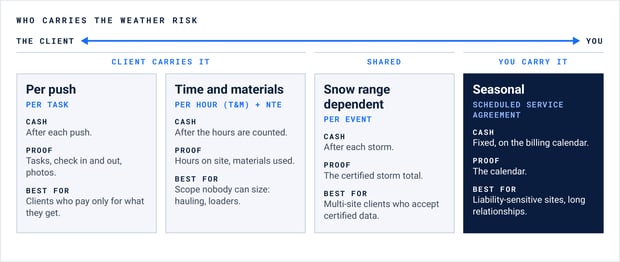
Read the contract, then set it up.
| Contract says | Set up in UtilizeCore | The invoice comes from |
| “Per push”, “each time we plow” | Per Task. Each push, salt application or shovel pass is a Task with its own rate on the Site. | Each verified Trip, one line per Task ticked. |
| “Snow range dependent” | Per Event. Ranges per Site, Sites connected to WeatherWorks. | Each storm's certified total, or the manual override. |
| “Seasonal”, “fixed monthly” | Scheduled Service Agreement. Not a billing method. Storm Trips are Non Billable on the Client side. | The Agreement's billing calendar. |
| “Time and materials” | Per Hour (T&M) for labor, materials as lines, Client NTE as the cap. | Check in to check out, plus materials. |
The one that costs the most. Per push is Per Task, never Per Service. A Per Service Trip with three pushes bills once.
Good to know. There is no per inch method: depth pricing lives inside Per Event. Purchase Order, Technician and Inspection are not billing methods. The full list of eight is in Billing Methods Explained.
Seasonal is an Agreement, not a billing method.
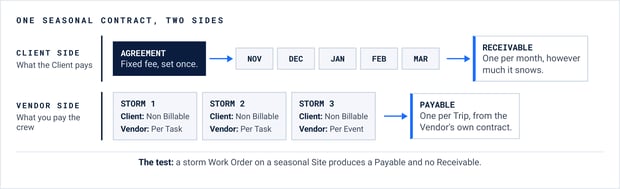
How it bills. The Agreement is the only Client bill. Storm Trips prove the work and pay the crew. Set the snow Service's Client side to Non Billable on seasonal Sites. The Vendor side follows the subcontractor's own contract.
Most contracts are a blend.
| Contract says | How to set it up |
| Seasonal, plus per push over N inches | Scheduled Service Agreement, plus Per Event on the storm Work Orders with a zero rate below N. Small storms are on the record and bill nothing. |
| Seasonal with a snowfall cap | The Agreement bills the fixed fee. Keep the Sites connected to WeatherWorks so the season's certified totals are on record. At season end, bill the overage as a manual line on a separate invoice. |
| Snow range dependent, plus a set price per salt application | Per Event, with the salt Task on Per Task Flat. Plowing prices from the range; each application adds its set price on the same invoice. |
| Snow range dependent, with a one-push minimum | Start the first range at the trigger depth and price it as one push, so a small storm still has a price. |
| A Client price that fits no type | A Client-specific Service with its own rates. It keeps the exception visible and out of other Clients' invoices. |
Outside snow, it is about cadence.
| Agreement | Set up in UtilizeCore | The invoice comes from |
| Fixed monthly scope | Scheduled Service Agreement, Separate Invoice Separate Work Order. Landscape, janitorial, lot programs. | The billing calendar, separate from the service calendar. |
| Per visit under contract | Scheduled Service Agreement, Invoice based from completed work order, priced from the Per Service rate. | Each completed Work Order. A missed visit shows up as a missing invoice. |
| PM plus repair | PM on an Agreement. Repairs found on the visit start as a Proposal from the PM Work Order. | The PM schedule, and each approved Proposal. |
| Inspection programs | An Agreement for the schedule, an inspection form on the Service. Deficiencies become Proposals. | Per Service per visit, or the fixed fee. |
Keep a mixed portfolio predictable. One Service per Trade. Agreement types attach through billing methods and rates, not new Services. And set the Client side and the Vendor side of every Trip separately. They rarely match.
Ask these before you quote.
| Ask | If | Lean toward |
| Can the Client absorb a bad month? | No | Seasonal |
| Is the Site liability-sensitive: retail, healthcare, public entrances? | Yes | Seasonal, with proactive treatment written in |
| Will the Client accept certified snowfall as the measure? | Yes | Snow range dependent |
| Do you have enough history to price a season? | No | Per push or snow range dependent this year, seasonal at renewal |
| Is part of the scope unsizeable: hauling, loaders, campus sidewalks? | Yes | Carve it out as time and materials with an NTE |
| Does the Client's finance team need every invoice tied to a visit? | Yes | Per push, or per visit under contract |
Price the risk you take. A seasonal fee should beat the expected per push total. You are selling certainty and keeping the variance. Price seasonal on several winters of history, and put a cap in the contract when the history is short.
Seven exceptions, seven corrections.
| Exception | Correction |
| Per push loaded as Per Service. Three pushes bill once. | Per Task, one Task per push type, each with a rate on the Site. |
| Contract says seasonal, Site set up to bill storms. The Client is invoiced twice. | The Agreement carries the Client billing. Storm Trips are Non Billable on the Client side. Run one test storm: a Payable and no Receivable. |
| Snow range dependent with no storm total source. Someone types a total from memory. | Connect the Sites to WeatherWorks. Elsewhere, use the bulk manual override with a documented source. |
| Per push with no record of the visit to a Site that was already clear. | A Did Not Service Task, Non Billable, and photos on every snow Service. |
| One Service per contract type: Snow Removal Seasonal, Per Push, Per Event. | One Service. The contract type lives in the billing method and the rates. |
| Vendor side copied from the Client side. The Vendor's Payable comes out at zero. | Set the Vendor billing method from the Vendor's contract, per Site. |
| Seasonal priced on last winter alone. | Price on multi-year history, with a cap clause when the history is short. |
Read next. Billing Methods Explained for the eight methods. Snow Season Setup to put a season's contracts into the platform. Rate Hierarchy for which rate wins.
Questions? Contact your Customer Success team or email support@utilizecore.com.